Modular Solution for Cosmetics Compliance
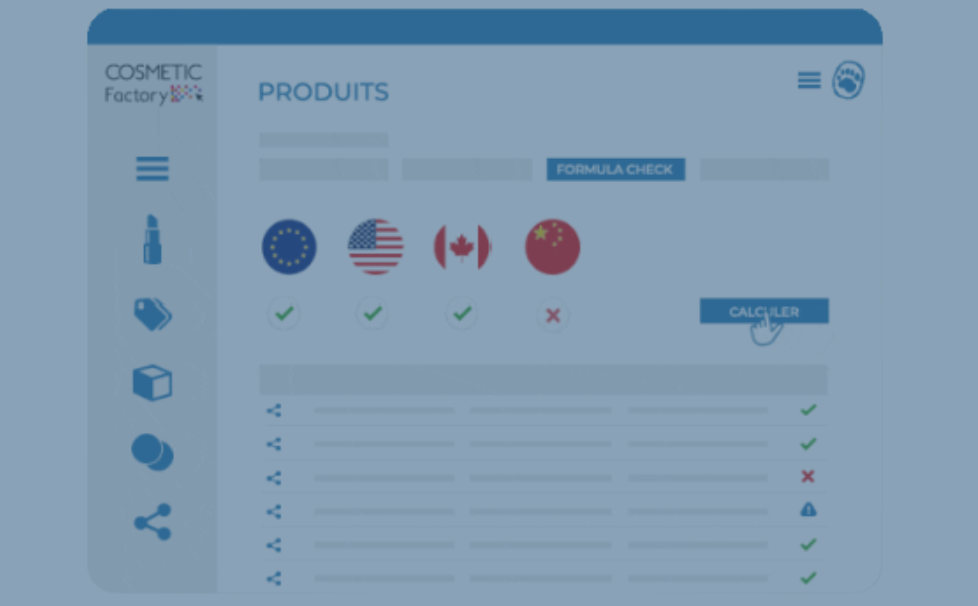
Check the Conformity of your Formulas
Secure your regulatory documents for each zone
Optimize on-site risk management
Manage your Safety Data Sheets efficiently
Automate your regulatory monitoring
Ensure the traceability of your substances
Maintain good HSE risk management
Learn how to verify cosmetic formula compliance across EU, US, and Canada with a practical, expert guide. Avoid reformulation and regulatory risks.
Recevez une fois par mois les dernières actus réglementaires et conseils d’experts.
Learn about the latest IFRA standards impacting cosmetic and homecare products. Discover new restrictions and additions to perfume ingredients. Find out about the transition period and how to stay compliant with the updated standards.
Learn the difference between dietary supplements and medications, and the risks associated with using medicinal plants in supplements. ANSES has developed a tool to help healthcare professionals inform consumers. Visit their website for more information.
The European Commission has authorized specific uses of 4-tert-OPnEO and 4-NPnEO, substances of very high concern, for in vitro diagnostic and life science kits until 2031. These substances, used in various industrial and medical applications, are listed due to their environmental risks.
New information requirements for REACH registration dossiers have been implemented by ECHA. Changes include substance identity and standard information requirements. ECHA aims to control substances registered above 1t/year by 2027. Additionally, ECHA has added 2 new substances to the SVHC candidate list.
The EU's environmental policy is based on 4 principles: Precaution, Prevention, Correction of environmental damage, and Polluter pays. Learn about key EU chemical regulations and the European Green Deal's objectives for a sustainable economy. Explore various environmental laws and directives impacting industries like chemicals, batteries, waste management, and due diligence.
The EU's Biocidal Products Committee has approved the inclusion of nitrogen generated from ambient air as a low-risk substance in the BPR Annex I. This decision facilitates the use of nitrogen for cultural heritage preservation, offering a non-toxic method of pest control.







.png)


